

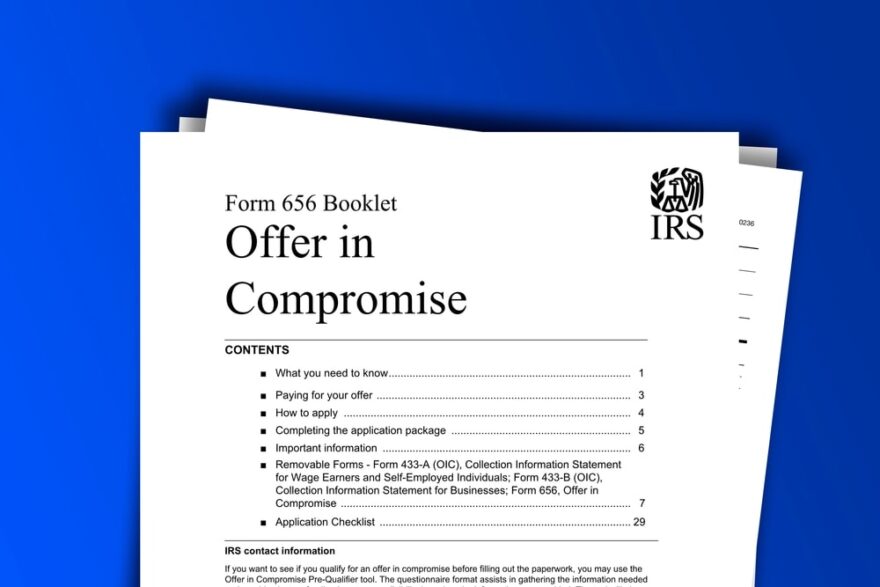
The Offer in Compromise program (OIC) allows taxpayers to settle their tax debt with the Internal Revenue Service (IRS) for less than the total amount owed. While this can be a helpful option for those facing significant financial hardship, the IRS does not accept every offer. They may return or reject an OIC for various reasons. Understanding these reasons can help you better prepare and increase the likelihood that your offer will be accepted.
Want to avoid a return or rejection of your offer? Learn about our offer-in-compromise services today.
Key Takeaways
- Returned ≠ Rejected. A return means the IRS never fully reviewed your offer. This could be due to missing forms, payments, or unfiled returns.
- Compliance is a prerequisite. All required tax returns must be filed, and estimated payments must be current before submitting and throughout the entire review period.
- Your initial payment is not optional. Include the application fee plus 20% of your offer (lump-sum) or the first installment (periodic). Low-income taxpayers must claim the fee waiver.
- The IRS calculates what you can pay. The most common reason for rejection is that the IRS believes your financial situation supports a higher payment than you offered.
- Noncompliance and misconduct can sink an offer. Offers can be rejected on the grounds of “not in the best interest of the government” or for “public policy considerations”, particularly for taxpayers with unreported income, a history of noncompliance, or criminal activity.
- You have 30 days to appeal. A rejection isn’t final. You can file an appeal with the IRS Independent Office of Appeals.
Reasons the IRS Might Return Your Offer
The IRS may return your OIC if it fails to meet specific preliminary criteria. Here are some common reasons why your offer might be returned:
1. Incomplete Forms and Documentation
If your OIC application is incomplete, the IRS will return it. This includes missing forms or failing to provide the financial information needed to determine your ability to pay, which helps the IRS decide whether your offer should be accepted or rejected. It is essential to ensure that all necessary forms, such as Form 656 (Offer in Compromise) and Form 433-A (OIC) (Collection Information Statement for Wage Earners and Self-Employed Individuals), are fully completed and submitted with the required supporting documentation.
2. Failure to Make Required Offer Payments
When you submit an OIC, you must include an application fee and initial payment unless you qualify as a low-income taxpayer. Depending on the type of offer you submit, your initial payment could be 20% of your offer or the first installment of a 6 to 24-month payment plan. If you fail to include the application fee or first payment, or if your payment is insufficient, the IRS will return your offer. In addition, the IRS may return your offer if you fail to make any required monthly installment payment while your offer is being evaluated.
3. Bankruptcy Proceedings
The IRS will not consider an OIC if you are in an open bankruptcy proceeding when submitting your offer or if you file bankruptcy while your offer is being investigated. The reason is that your financial situation is already under the bankruptcy court’s jurisdiction, and an OIC would conflict with the bankruptcy process.
4. Failure to File Required Tax Returns
You must be current with all your tax return filing requirements to be eligible for an OIC. If you have outstanding returns, the IRS will return your offer until all required returns are filed.
5. Failure to Make Sufficient Estimated or Withholding Tax Payments
You must make estimated tax payments or have income tax withheld that is sufficient to cover the estimated tax of the tax year the offer was submitted, and you must remain compliant with estimated tax payments or have sufficient withholding in any year after the offer is submitted. Failure to meet these tax obligation requirements will result in a return of your offer.
6. Soley to Delay
Your offer will be returned if the IRS finds it was submitted solely to delay the collection process. The IRS examines various factors to determine if you’re filing an OIC to avoid enforced collection activity. For example, you submit an offer that is not materially different from a previous offer that was considered and rejected.
Dealing with a Return of Your Offer
Typically, before the IRS returns your offer, they will give you the opportunity to provide missing information, tax returns, or outstanding payments. Therefore, it’s important that you respond promptly to their requests to avoid having your offer returned.
Upon receipt of a return letter, taxpayers may contact the IRS to object to the return of an offer. The IRS realizes that sometimes situations may arise when reconsidering a returned offer would best serve the interests of both the IRS and the taxpayer.
If you are unsuccessful with either of the above, you can resubmit the offer once the deficiency has been corrected.
Reasons the IRS Might Reject Your Offer
Even if your offer meets the initial criteria and is not returned, it can still be rejected after further review. Here are some reasons why the IRS might reject your OIC and signs you may want to consider another type of tax debt relief:
1. Ability to Pay More
In determining whether to accept your offer, the IRS will evaluate your income, expenses, and asset equity to determine your ability to pay. The most common reason offers are rejected under the Offer in Compromise program is that the IRS believes, based on your financial situation, that you have the ability to pay more than the amount you offered.
The IRS policy is to try contacting you by phone before sending a rejection letter. They will explain how they calculated the amount they believe you can pay and give you a chance to provide any additional financial information.
2. Not in the Best Interest of the Government
The IRS can decide whether and when to accept an offer to compromise a liability. Sometimes, a rejection of an offer may be based on a determination that accepting the offer is not in the “best interest of the government” (NIBIG). Offers rejected as NIBIG require the review and approval of either a Territory Manager or Operations Manager.
Examples of situations that may warrant rejection under NIBIG include:
- The taxpayer has a significant history of past noncompliance and does not appear to be currently reporting income accurately. The taxpayer failed to report all income in recent tax years and did not pay the taxes owed when able to do so.
- Refund schemes that involve unsubstantiated withholding on forms W-2 and erroneous refundable credits, in which the taxpayer received fraudulent refunds.
- Preparer, Promoter, Appraiser, Material Advisor, and Aiding & Abetting Penalties/ Return Preparer Fraud or Misconduct.
3. Public Policy Considerations
Under the Offer in Compromise program, the IRS may reject an OIC if they believe that accepting it could undermine public confidence in the tax system, even if the offered amount is greater than what could be collected by other means. This is an unusual situation that usually involves serious misconduct by the taxpayer.
The following are two examples where rejection based on public policy considerations can occur:
- The taxpayer has openly encourage others to refuse to comply with the tax laws in the past and continues to do so.
- Indicators exist showing that the financial benefits of criminal activity are concealed or the criminal activity is continuing.
4. Doubt as to Liability Rejections
In addition to filing an OIC based on doubt as to your ability to pay the total amount due, taxpayers can file a doubt as to liability (DATL) offer when they disagree with the amount the IRS believes they owe. Generally, the IRS will reject offers based on DATL when the liability is believed to be correct as assessed, or the taxpayer will not withdraw the offer after the account has been adjusted.
Appeal Rights
Taxpayers can appeal a rejected OIC to the Independent Office of Appeals. The IRS will send a rejection letter explaining the appeal process, giving the taxpayer a 30-day window to file the appeal.
How to Improve Your Chances of Acceptance in the Offer in Compromise Program
While the Offer in Compromise program can offer relief for taxpayers struggling with tax debt, it’s crucial to understand the reasons why the IRS might return or reject your offer. By ensuring your submission is accurate, complete, and reasonable, and by maintaining compliance with all tax obligations, you can improve your chances of reaching a favorable agreement with the IRS.
Consider retaining a tax resolution firm such as East Coast Tax Consulting Group, which has extensive experience submitting Offers in Compromise. We can help you navigate the complex OIC process. Remember, honesty and thoroughness are key to a successful Offer in Compromise.
If an alternative relief option is better for your situation, we’ll let you know, explain why, and help you apply.
Frequently Asked Questions
What is the difference between a “rejected” and a “returned” OIC?
A rejected offer has been considered and denied on the merits, but you have the right to appeal. A returned offer was not processed because you failed to include the required application fee, initial payment, or necessary forms. Returned offers do not carry appeal rights, but you can resubmit.
What can I do if my OIC is rejected?
You have 30 days from the date of the rejection letter to appeal the decision to the IRS Office of Appeals by filing Form 13711 (Request for Appeal of Offer in Compromise). The appeal must explain why you disagree with the rejection and include any supporting documentation. Missing the 30-day deadline will forfeit your right to appeal.
What happens after I appeal a rejected OIC?
Your case is reviewed by an independent IRS Appeals Officer who was not involved in the original decision. The officer will review your financial information, the basis for rejection, and any new evidence you submit. You may negotiate a revised offer amount during this process. Appeals decisions are typically final within the IRS, though there are times when you may petition the Tax Court.
What are my alternatives if my OIC is rejected and I can’t pay in full?
Several options exist, including:
- Partial Pay Installment Agreement — you make reduced monthly payments toward your tax debt, with any unpaid balance expiring after the 10-year collection statute ends.
- Currently Not Collectible (CNC) status — the IRS temporarily suspends collection if you demonstrate severe financial hardship
- Penalty Abatement — request removal of penalties (though not the underlying tax) if you have reasonable cause or qualify for first-time penalty abatement
- Bankruptcy — certain income tax debts may be dischargeable in bankruptcy depending on specific eligibility rules
Should I hire a tax professional to help with an OIC or appeal?
While you can submit and appeal an OIC yourself, the process involves complex financial disclosures and negotiation. Enrolled agents, CPAs, and tax attorneys who specialize in IRS resolution can significantly improve your chances of acceptance by accurately calculating your RCP, presenting your finances in the most favorable legitimate light, and navigating the appeals process. Be cautious of companies that guarantee OIC acceptance; no one can guarantee IRS approval.